
A real jyotishi will tell you what the chart does not show. That single habit separates a considered reading from a frightening one more reliably than any credential. Everything below is a way of finding out, in the first few minutes, which kind of sitting you have walked into.
Ask these before you pay. An astrologer who has done the work will answer all seven without hesitation, and will not mind being asked.
1. What is your background, and how long have you practised?
You are asking who taught them and for how long they have been reading charts. Jyotishya is passed down — through a guru, a family line, or formal study at a Sanskrit institution — and a practitioner can normally tell you exactly where theirs came from.
A good answer sounds specific: who they studied under, how many years, what they read most. A vague answer about a gift or an intuition, with nothing behind it, is worth noticing.
2. Which system do you follow, and why?
There is more than one. Parashari is the mainstream of Vedic practice; Jaimini uses a different logic; Nadi, Krishnamurti Paddhati and Tajika each have their own methods. They are not interchangeable, and they can reach different conclusions from the same chart.
A good answer names the system and explains why it suits your question. It should also mention the ayanamsa in use — Lahiri is the Indian standard — because that setting shifts every planetary position. Two astrologers using different ayanamsas will disagree, and neither is lying.
3. What birth details do you need?
The right answer is date, exact time and place. Then a follow-up question you very much want to hear: how certain are you of the time?
The ascendant moves through a full sign in about two hours, and every house position moves with it. An astrologer who accepts a rounded-off time without asking how sure you are has skipped the most consequential question of the sitting. One who asks, and offers rectification when the time is uncertain, is doing the work properly.
4. How do you analyse the chart and reach a conclusion?
You are not asking to be taught astrology. You are asking whether there is a method.
A good answer describes a sequence — the ascendant and its lord, the houses relevant to your question, planetary strength and affliction, the yogas present, then the dasha sequence for timing and transits for the current period. It should be recognisably the same procedure for every client.
If the answer skips straight to a conclusion with no visible route to it, you are being told a result rather than shown a reading.
5. What can you predict, and what can you not?
This is the question that separates the trade. The limits are real and a competent practitioner states them without being pushed.
A chart is read for tendency, timing and pressure. It is not a substitute for a doctor, a lawyer or an accountant, and it does not fix a date of death — a reputable astrologer will refuse that question outright, particularly about a child. Guruji's own disclaimer says the guidance is offered for reflection and is not a substitute for medical, legal or financial advice, and that is the position you should expect.
Anyone promising a guaranteed outcome has left the discipline. Jyotishya describes conditions; it does not underwrite results.
6. How is my information kept private?
You are handing over your birth details, your family circumstances, often a marriage difficulty or a health worry. It is entirely reasonable to ask what happens to it.
A good answer is plain: who sees it, where it is stored, and that it will not be discussed with relatives who ring up afterwards. Be wary of any practice that displays clients' charts or family problems publicly as advertising.
7. What is the fee, how long is the sitting, and what is included?
Ask before, not after. A settled practice has settled fees and can tell you the number, the duration, and whether anything is provided in writing.
For reference, Guruji's own fees are published rather than quoted on the day: ₹1,100 for a twenty-minute focused question, ₹2,500 for a sixty-minute detailed kundali reading with a written remedy sheet, ₹5,100 for the ninety-minute sitting with a full written report. You can disagree with the numbers; the point is that they are on the website before you arrive.
A fee that changes according to how worried you appear is the clearest warning sign in this list.
Four things worth walking away from
- A guaranteed result. Nobody can underwrite an outcome, and the promise is the surest sign of a sales process rather than a reading.
- A price that rises with your distress. If the remedy costs more because you are frightened, the fear is the product.
- A serious dosha found in every chart. Some afflictions are genuinely common. A practice where everyone who walks in is gravely afflicted is running a script.
- Remedies sold on the spot. There is a plain conflict of interest when the person diagnosing also sells the cure at a margin. Ask what the remedy is, why the chart calls for it, and whether you can source it yourself.
What a straight reading actually sounds like
Measured rather than dramatic. It names periods rather than certainties. It distinguishes what the chart indicates strongly from what it only hints at. It says plainly when a question is outside what astrology can answer, and points you to a doctor or a lawyer instead.
It also tells you good news without inventing a problem to solve. A chart with no serious affliction should produce a sitting that says so, and the sitting is not a failure for having said it.
What to bring
- Date of birth, and the most accurate time you can establish
- Place of birth — the town or village, not just the state
- How confident you are in the time, said honestly
- The specific question, written down before you arrive
- Any previous reading you want checked, and who gave it
Writing the question down beforehand is worth more than it sounds. It keeps the sitting on the thing you actually came for.
These seven questions describe how Guruji works, so of course the article suits him. Use them on anyone, including him. An astrologer who resents being asked has told you something useful.
Where this leaves you
If a previous reading frightened you, take the questions above to whoever gave it and see how the answers hold up. If you would like a second opinion on a chart that has already been read, bring both the chart and what you were told. Sittings are in person at Whitefield, Bangalore, or online.
Common questions
How do I know if an astrologer is genuine?
Ask where they studied, which system and ayanamsa they use, and how they reach a conclusion. A genuine practitioner answers all three without hesitation and will also tell you plainly what a chart cannot show. Certainty about everything is a warning sign, not a qualification.
How much should an astrology consultation cost in Bangalore?
A settled practice publishes its fees rather than quoting on the day. Guruji's are ₹1,100 for a twenty-minute focused question, ₹2,500 for a sixty-minute detailed kundali reading, and ₹5,100 for the ninety-minute sitting with a written report. The number matters less than whether it was fixed before you walked in.
Should an astrologer sell me gemstones?
There is a plain conflict of interest when the person diagnosing also sells the remedy at a margin. A gemstone is sometimes genuinely indicated. Ask why the chart calls for it, which planet it addresses, and whether you may source it yourself — and be cautious of anyone who objects to that last question.
Can an astrologer guarantee a result?
No. Jyotishya reads tendency, timing and pressure; it does not underwrite outcomes. A guaranteed result is a sales promise rather than an astrological one, and it is the clearest signal to walk away.
Is it normal to be told I have a dosha?
Some afflictions are genuinely common — mangal dosha alone implicates half the houses of a chart on the quick check. What is not normal is every client being gravely afflicted and every affliction needing an expensive remedy. Ask which cancellation conditions were tested before the verdict was given.
What should I bring to a consultation?
Your date of birth, the most accurate time you can establish, and your place of birth down to the town. Say honestly how certain you are of the time. Write your question down beforehand, and bring any previous reading you want checked.
Is an online consultation as good as sitting in person?
For a chart reading, yes — the chart is the same either way and the sitting is a conversation. In person is better for palmistry and necessary for vastu, where the space itself is being read. Guruji offers both, and will tell you if your question needs the in-person sitting.
About the author
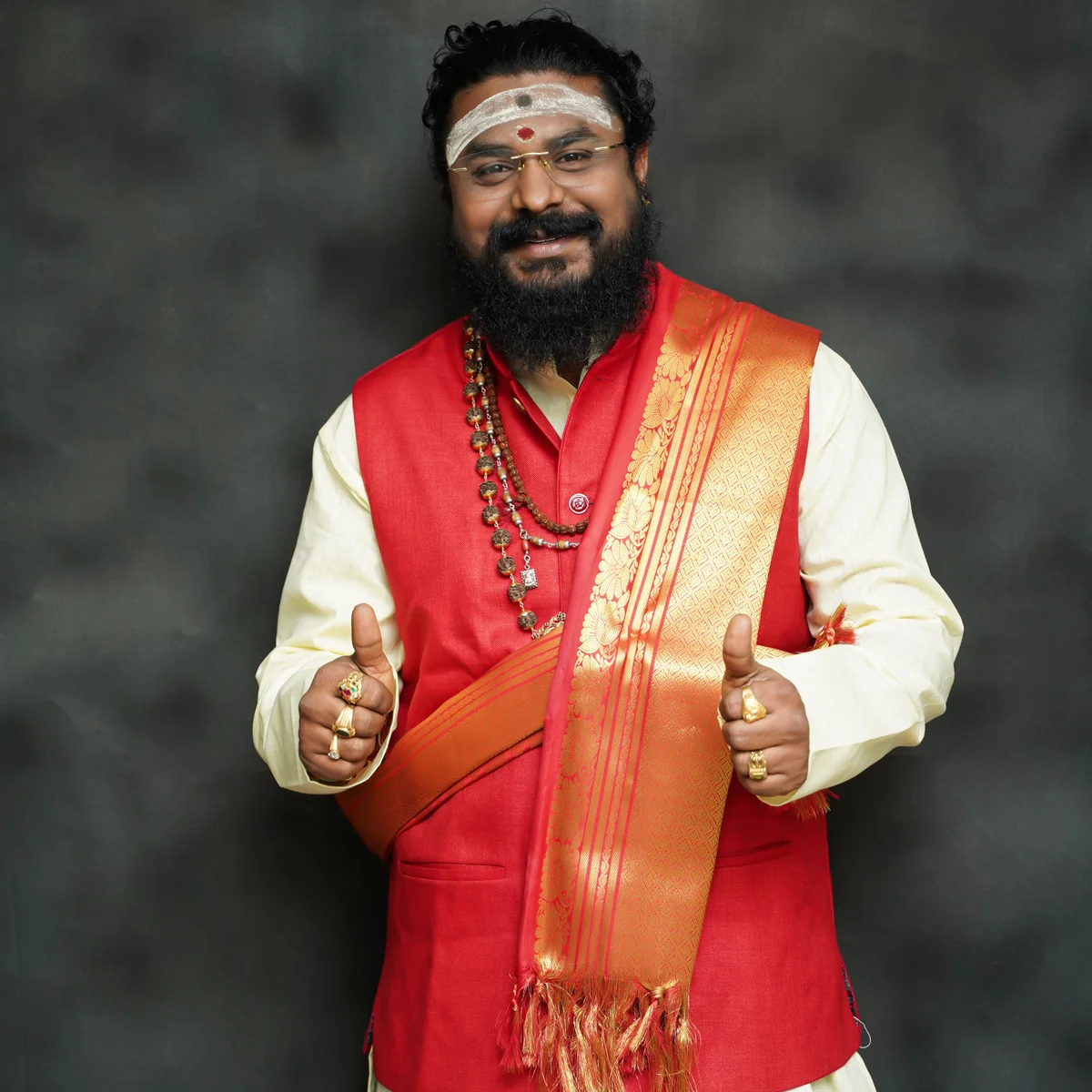
Dr. Pandit Sri Sidhant Arun Sharma Guruji has practised Vedic astrology for over twenty-five years and has guided more than fifty thousand consultations from Sri Mookambika Jyothishyalaya in Whitefield, Bangalore. He reads janma kundali and kundali matching, palmistry and Vedic numerology, vastu, and the classical remedies for graha afflictions, in Kannada, Hindi, English and Telugu.
He holds Jyotishya Ratna and Jyotishya Vibhooshana, and was named Best Astrologer of the Year in 2023. More about Guruji · Book a sitting